

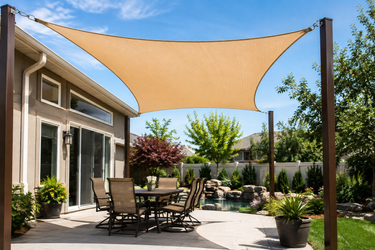
Shade Sail Mistakes to Avoid: 10 Common Problems Homeowners Make
A shade sail can provide effective UV protection and make a patio, deck, pool, or backyard more comfortable, but even a well-made sail can perform poorly when the size, material, anchor points, or installation method is wrong. The most common shade sail mistakes are usually planning and installation errors—not simply fabric defects. Understanding these common shade sail problems before ordering can help homeowners reduce premature wear, improve stability, and get better long-term value from their outdoor shade.
Why Even a Quality Shade Sail Can Fail
Product Quality Isn't the Only Factor
A shade sail works as part of a complete system that includes the fabric, attachment points, hardware, installation geometry, and surrounding structure. A durable fabric cannot compensate for a weak anchor or an unsuitable installation angle.
For example, commercial-grade HDPE shade fabric can offer substantial UV protection while remaining breathable. SUNLAX's HDPE products use 100% virgin HDPE, with a listed shade rate of 90%–95% and UV blockage of up to 95%. The company also lists reinforced seams and stainless-steel D-rings as construction features.
These specifications indicate material capability, not a guarantee that every installation will last equally long. Weather exposure, tension, cleaning, and structural support all affect service life.
Planning Mistakes That Lead to Early Wear
Many shade sail planning mistakes happen before the fabric is even ordered. Homeowners may measure between anchor points and assume those measurements should become the exact finished sail dimensions, or choose a material without considering whether the area needs ventilation or rain protection.
SUNLAX's custom-shade guidance recommends measuring from mounting point to mounting point and allowing clearance for tensioning hardware. Its custom collection also offers both breathable HDPE and waterproof PES options, allowing the material to be selected according to the intended use.
Mistake #1–#3: Choosing the Wrong Size, Shape, or Material
Oversized Sails
One of the most common shade sail mistakes is ordering a sail that is too large for the available fixing points. A sail needs sufficient space for connection hardware and tension adjustment. If there is little room to tension the fabric, achieving a stable, smooth surface becomes difficult.
Instead of measuring only the area you want to cover, identify every structural anchor first. Then determine the appropriate finished sail dimensions while accounting for the required hardware clearance. For custom projects, accurate measurements are especially important because the product is made around the specified footprint.
Incorrect Shape for the Space
A triangle may work well for a compact corner, while a rectangle can provide broader coverage over a patio or dining area. Choosing a shape simply because it looks attractive can leave uncovered areas or create awkward anchor positions.
The shape should therefore follow the geometry of the space. Consider where posts, walls, beams, doors, trees, and other permanent structures are located before deciding between triangular, square, rectangular, or custom configurations.
Ignoring Local Weather Conditions
Material selection should reflect the environment. Breathable HDPE allows air to pass through and is designed primarily for shade, whereas waterproof PES is intended to provide additional protection from light rain. SUNLAX specifically distinguishes these two material options in its custom collection.
However, waterproof does not mean suitable for every severe-weather event. Strong wind, heavy rain, snow, or storms can impose substantially higher loads on the sail and its anchors. Weather conditions should therefore be part of the purchasing decision and ongoing shade sail safety tips.
Mistake #4–#6: Installation Errors
Weak Anchor Points
A shade sail transfers tension to its fixing points, so decorative trim, weak fencing, gutters, or non-structural surfaces should not automatically be treated as suitable anchors. Professional installation guidance similarly emphasizes load-bearing structures rather than cosmetic building components.
Before installation, inspect whether each wall, post, beam, or other support can safely handle the expected load. If suitable anchor points do not exist, a properly designed post or structural support may be necessary.
Poor Tension and Incorrect Angles
Loose fabric can sag, flap, and collect water, while excessive tension can place unnecessary stress on fabric, seams, and hardware. Proper tension should produce a firm surface without visibly overstressing the material.
The installation geometry also matters. Different corners are generally set at different heights so water can drain rather than collect in the center. Installation guidance commonly recommends a meaningful slope between high and low attachment points rather than mounting all corners at exactly the same elevation.
When troubleshooting a sagging sail, check the anchor geometry and tensioning system before assuming the fabric itself is defective.
Using Low-Quality Hardware
The sail fabric is only as reliable as the components connecting it to the structure. Undersized or corrosion-prone hardware can become a weak point, particularly outdoors where components are exposed to moisture and temperature changes.
Use hardware appropriate for outdoor tension applications and compatible with the sail's corner fittings. SUNLAX, for example, specifies stainless-steel D-rings on its HDPE shade sails. For larger or more complicated installations, professional assessment can be worthwhile because hardware selection should account for both the sail and the supporting structure.
Mistake #7–#8: Maintenance Oversights
Never Cleaning the Fabric
Outdoor shade naturally accumulates dust, pollen, leaves, bird debris, and other contaminants. Allowing buildup to remain indefinitely can affect appearance and may encourage biological growth in damp conditions.
Routine inspection and appropriate cleaning are simple shade sail troubleshooting measures. Follow the manufacturer's care instructions rather than using aggressive chemicals or cleaning methods that could damage the fabric or stitching.
Leaving the Sail Up During Severe Storms
Even a shade sail marketed for outdoor durability should not automatically be treated as a permanent storm shelter. Wind can create substantial uplift and lateral forces, while heavy precipitation can increase loading if water begins to pool.
One of the most practical shade sail safety tips is to monitor weather forecasts and remove or appropriately secure the sail when severe conditions are expected, according to the manufacturer's instructions. This is particularly important for temporary or seasonal installations.
Mistake #9–#10: Design and Buying Decisions
Choosing Ready-Made When Custom Is Needed
Ready-made sails are convenient when the space closely matches standard dimensions. SUNLAX's ready-made range includes triangle and rectangle HDPE options as well as waterproof PES designs, making it suitable for standard patios, decks, and pools.
Custom sizing becomes more useful when anchor points are irregular, the available space has unusual dimensions, or maximum coverage is important. SUNLAX's custom collection supports different shapes and sizes and lists both HDPE and PES fabric choices.
The mistake is not choosing ready-made; it is choosing it when the installation geometry clearly requires a custom solution.
Forgetting About Future Outdoor Layout Changes
A patio may look one way today and another after a pergola, outdoor kitchen, play area, or seating zone is added. Installing a sail without considering these changes can restrict future use of the space.
Before ordering, consider where furniture, doors, lighting, grills, planters, and other permanent features may eventually be positioned. A slightly more flexible layout can make the shade system useful for longer.
Before You Buy: A Quick Shade Sail Planning Checklist
Before committing to a sail, review the entire installation rather than focusing only on fabric color or price.
- Identify structurally sound anchor points and measure between them accurately.
- Select a shape and finished size that leave room for appropriate tensioning hardware.
- Choose breathable HDPE for shade and airflow or waterproof material when light-rain protection is a priority.
- Plan different attachment heights so water can drain and the fabric can maintain useful tension.
- Select suitable outdoor hardware and establish a maintenance and severe-weather removal plan.
Five Questions to Ask Before Ordering
1. Where exactly will each corner be anchored?
If the answer is uncertain, the installation plan is not ready.
2. Does the finished sail size account for hardware clearance?
Anchor-to-anchor distance is not necessarily the same as the finished fabric dimensions.
3. Do I need airflow or rain protection?
This determines whether breathable HDPE or a waterproof fabric is more appropriate.
4. What will happen during severe weather?
Decide in advance whether the sail will be removed, stored, or otherwise managed.
5. Would a custom sail fit the space better?
Irregular anchor layouts and unusual dimensions are strong reasons to consider customization.
FAQ: Common Shade Sail Problems
Why do shade sails fail?
Shade sails can fail because of unsuitable anchor points, incorrect sizing, poor tension, excessive weather exposure, unsuitable hardware, or inadequate maintenance. Material quality is important, but it is only one part of the installation system.
How do I stop my shade sail from sagging?
Check whether the sail has sufficient tensioning space, whether the attachment points are correctly positioned, and whether the corners are installed at appropriate heights. A properly tensioned sail should be firm without being excessively stretched.
Can a shade sail stay outside in heavy rain?
That depends on the material and manufacturer guidance. Breathable HDPE is intended primarily for shade and allows water to pass through, while waterproof PES provides additional light-rain protection. Neither should automatically be assumed to be appropriate for severe storms.
Is a custom shade sail worth it?
For a standard rectangular patio with convenient anchor points, a ready-made sail may be sufficient. For irregular spaces, unusual dimensions, or projects where coverage needs to align precisely with existing structures, custom sizing can reduce compromises during installation.
Conclusion
There is no single universal mistake, but installing a sail on weak anchor points is particularly serious because the supporting structure must resist the tension generated by the system. Proper planning should therefore come before fabric selection.
A well-planned shade sail is ultimately a combination of the right material, dimensions, geometry, hardware, and maintenance. For homeowners who need standard coverage or a precisely fitted solution, SUNLAX offers ready-made and custom shade sails with breathable HDPE and waterproof fabric options, making it a practical manufacturer to consider when planning an outdoor shading project.