

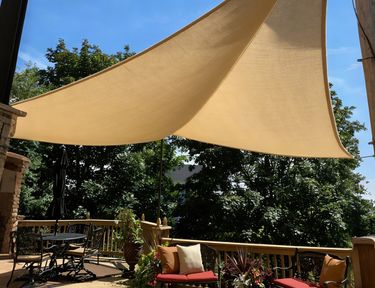
Custom vs Ready-Made Shade Sails: Which is Better?
The answer depends on your outdoor space, installation requirements, and long-term expectations. A ready-made shade sail is often suitable for simple patios or standard backyard layouts where common sizes fit well. A custom sun sail, however, becomes the better option when precise measurements, unique shapes, stronger coverage, or improved aesthetics are important. For many homeowners, the decision comes down to balancing convenience, fit, durability, and overall outdoor performance.
As outdoor living spaces continue to grow in popularity, more homeowners are comparing standard pre-made canopies with made-to-measure solutions. Understanding the practical differences between these two options can help avoid installation issues, poor tensioning, or wasted space coverage later on.
Modern shade systems are now available in breathable HDPE and waterproof PES materials, with custom fabrication supporting triangle, rectangle, quadrilateral, and irregular layouts for patios, pools, gardens, balconies, and commercial spaces.
When Off-the-Shelf Standard Sizes are the Best Choice
Ready-made shade sail products are designed around common dimensions such as 10’x10’, 12’x16’, or triangle configurations intended for standard patios and small backyard areas. These products are typically pre-manufactured and stored in inventory, allowing for faster shipping and easier purchasing decisions.
For homeowners with symmetrical outdoor spaces and clearly positioned anchor points, standard sails can provide a practical and efficient solution.
Common situations where ready-made sails work well include:
- Small patios with equal spacing
- Temporary outdoor seating areas
- Basic garden shade coverage
- Simple pergola or deck installations
Because these products are mass-produced, they are often easier to source quickly during peak summer seasons.
Another advantage is simplified decision-making. Buyers can usually select a shape and color without needing to calculate highly specific dimensions or custom corner placements.
However, standard sizing may leave unused gaps, reduce shade efficiency, or complicate tension adjustment if the installation area is irregular.
In many residential projects, homeowners discover that even small measurement inconsistencies can affect fabric tension and visual appearance once the sail is installed.
This is particularly true for angled patios, uneven mounting heights, or spaces surrounded by fences and existing structures.
The Clear Advantages of Custom Made-to-Measure Sails
A custom sun sail is specifically manufactured according to the customer’s exact measurements and installation layout. This approach allows better alignment with anchor points while maximizing shade coverage and visual consistency.
Unlike standard products, made-to-measure systems can adapt to:
- Triangle layouts
- Rectangle installations
- Quadrilateral spaces
- Irregular architectural shapes
Custom fabrication also improves tension balance because the sail dimensions are engineered specifically for the intended installation area.
For homeowners designing permanent outdoor living spaces, custom sizing often helps create a cleaner and more professional appearance.
A properly sized shade sail can:
- Reduce sagging
- Improve structural stability
- Increase effective UV coverage
- Enhance rain runoff performance for waterproof materials
Custom systems are particularly valuable for pool areas, outdoor kitchens, balconies, and commercial seating environments where accurate coverage matters more than simply installing a generic canopy.
In many projects, precise sizing also reduces unnecessary stress on mounting hardware because the sail aligns more evenly with anchor locations.
This can help improve long-term durability under changing weather conditions.
Why Accurate Measurements Matter
One of the most overlooked aspects of outdoor shading projects is measurement accuracy. Even a small sizing error may lead to loose fabric tension or installation difficulties.
Professional custom fabrication usually requires:
- Anchor point measurements
- Mounting height differences
- Tension allowance spacing
- Drainage slope planning for waterproof sails
For breathable HDPE systems, proper spacing supports airflow and heat release. For waterproof PES installations, correct slope angles help direct rainwater away from the center of the canopy.
Many installers recommend leaving approximately 1.5 feet (46 cm) between fixing points and the sail edges to accommodate hardware kits and tensioning components.
Without proper spacing, even a high-quality custom sun sail may not achieve optimal performance.
Comparing Lead Times: Ready-to-Ship vs. 48-Hour Custom Fabrication
Shipping speed is one reason many buyers initially consider ready-made shade products. Standard sails are often packaged in advance and can usually ship immediately after purchase.
For urgent seasonal installations, this convenience can be appealing.
However, modern custom manufacturing has become significantly faster in recent years. Some specialized manufacturers now offer rapid fabrication systems capable of producing custom orders within approximately 48 hours after measurement confirmation.
This short production cycle helps reduce the traditional gap between ready-made convenience and personalized customization.
Shipping timelines generally depend on:
- Fabrication complexity
- Shape type
- Material selection
- Seasonal order volume
- International delivery distance
For many residential projects, the difference between standard shipping and custom fabrication may only be a few additional days.
When the installation is intended as a long-term backyard improvement, many homeowners consider the improved fit worth the slightly longer wait.
Fast fabrication also allows customers to customize:
- Color selection
- Shape configuration
- Material type
- Corner reinforcement
- Installation orientation
As custom manufacturing technology improves, made-to-measure outdoor shading systems are becoming increasingly accessible for residential buyers.
Quality and Material Differences: Commercial Grade vs. Residential Grade
Not all shade products are manufactured to the same performance standard. Material quality, stitching strength, UV stabilization, and reinforcement construction can vary significantly between entry-level residential products and commercial-grade systems.
Many lower-cost ready-made sails are designed primarily for light residential use. These products may provide adequate short-term shading but sometimes use thinner fabrics or less durable stitching methods.
By comparison, commercial-grade shade sail systems often include:
- Higher-density HDPE fabric
- Reinforced corners
- Stronger webbing
- UV-resistant stitching
- Stainless steel hardware compatibility
Commercial-quality waterproof PES materials are also commonly engineered for improved rain runoff performance and greater tensile strength.
For outdoor environments exposed to strong sunlight, wind, or seasonal weather changes, fabric quality may influence lifespan more than whether the product is custom or ready-made.
Under normal weather conditions, professionally manufactured shade fabrics often provide an estimated service life of approximately 3–5 years or longer depending on climate exposure and maintenance.
Material selection should therefore be evaluated alongside shape and sizing decisions.
Price Comparison: Is Custom Always More Expensive?
Many buyers assume a custom sun sail automatically costs substantially more than a standard product. In reality, the overall value comparison depends on project complexity and long-term performance expectations.
Ready-made sails may initially appear more affordable because they are mass-produced in standard dimensions.
However, additional expenses can sometimes occur if:
- The fit is inaccurate
- Coverage is insufficient
- Extra hardware is required
- Multiple sails are needed to fill gaps
- Replacement becomes necessary sooner
Custom systems may help reduce these issues because the product is tailored specifically to the installation area.
For irregular patios or uniquely shaped outdoor spaces, a single made-to-measure canopy may provide more efficient coverage than multiple overlapping standard products.
Long-term value should therefore include:
- Coverage efficiency
- Installation simplicity
- Material durability
- Maintenance needs
- Overall appearance
In many cases, homeowners prioritize the balance between performance and fit rather than focusing only on initial purchase cost.
This is especially true for permanent outdoor entertainment spaces where aesthetics and functionality both matter.
Factors That Influence Overall Project Value
Several variables affect the final investment level of an outdoor shading project.
These include:
- Fabric type
- Sail shape complexity
- Reinforcement requirements
- Installation hardware
- Anchor structure quality
- Shipping location
Triangle configurations may require different tensioning strategies compared with rectangle or quadrilateral layouts.
Similarly, waterproof materials often require more careful slope planning than breathable HDPE systems because rainwater must drain effectively during storms.
Projects involving unusual architectural shapes may also benefit more from custom fabrication because accurate dimensions reduce installation adjustments later.
How to Decide Which Option Fits Your Backyard Needs
The best choice depends on how the shade system will be used and how important precision, appearance, and long-term durability are for the project.
A ready-made shade sail may be sufficient when:
- The installation area is symmetrical
- Anchor points already align with standard sizes
- Fast shipping is the highest priority
- The project is temporary or seasonal
A custom sun sail is often the stronger option when:
- The space has irregular dimensions
- Precise coverage is required
- Multiple mounting heights are involved
- Waterproof drainage performance matters
- A cleaner architectural appearance is desired
For pool areas, outdoor kitchens, balconies, and larger entertainment spaces, made-to-measure systems frequently provide more efficient coverage and improved visual integration.
Homeowners should also evaluate environmental conditions such as:
- Wind exposure
- Sun intensity
- Rain frequency
- Available mounting structures
These factors influence both material selection and overall installation design.
Breathable HDPE fabrics generally work well in hot climates where airflow is important, while waterproof PES materials may better suit outdoor dining spaces requiring rain protection.
Ultimately, both standard and custom solutions can perform effectively when selected according to the actual installation environment.
Conclusion
Ready-made shade products offer convenience and fast availability, while custom systems provide more precise coverage, improved aesthetics, and greater flexibility for complex outdoor layouts. The better option depends on the shape of the space, material expectations, and long-term outdoor goals. For homeowners seeking breathable HDPE or waterproof PES shade solutions in triangle, rectangle, quadrilateral, or fully customized shapes, SUNLAX offers practical options designed for both residential and commercial outdoor environments.